

How to Convert a Tennis Court into four Pickleball Courts
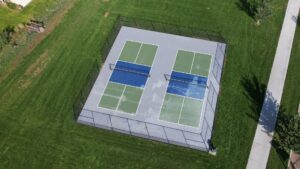
The city had an aging tennis court at one of its parks, demand for pickleball was off the charts, and the council wanted four pickleball courts in that footprint by summer.
The pad measured 60 by 120″. On paper, that fits four pickleball courts.
In reality, the corners were cut at forty five degrees, and the project went from “stripe new lines and call it done” to a full reconstruction conversation in about ten minutes.
If you are a parks and recreation department, a municipal facilities manager, or a city engineer looking at a tennis-to-pickleball conversion anywhere in Nebraska or the Midwest, we need to take the “California Corners” in consideration.
What Is a California Corner, and Why Was It Built That Way?
A California corner, sometimes called a cut corner, is a forty five degree bend in the perimeter fence line at each of the four corners of a tennis court enclosure. Instead of a true ninety degree corner, the fence cuts diagonally across the corner, usually about fourteen feet.
They were a deliberate design choice on a huge number of tennis courts built in the second half of the twentieth century, and they served two real purposes.
- They reduced cost. Less pavement, less fencing, less material across hundreds of courts adds up to a meaningful budget difference for a parks department or a club building several courts at once.
- They kept the game moving if an errant ball hit deep into a true ninety degree corner has a way of dying in that pocket, and a player has to walk back, retrieve it, and reset. A diagonal corner deflects the ball back toward the center of the court, which means fewer interruptions and a faster pace of play.
Tennis culture, especially at the municipal and club level, accepted cut corners as a sensible trade. Most of the courts built in city parks across the Omaha metro and across Nebraska from the 1960-1990s have them.
The trouble is that they were designed for tennis, not anticipating that pickleball demand would grow and people would re-purpose these courts.
Why Do California Corners Cause Problems for Pickleball Conversion?
A standard tennis court pad is sixty feet wide by one hundred twenty feet long. That is theoretically enough room to fit four pickleball courts, which each need about thirty by sixty feet of playing area plus run-off space.
But that math assumes a true rectangle…not one with missing corners that amount to a total of 200 square feet in total.
When the corners are cut at forty five degrees, the four pickleball courts get pushed inward to avoid the diagonal edges. The two courts on each end lose run-off space behind the baseline. Players run into the fence line. Side-by-side courts get pushed close enough that play on one court interferes with play on the neighbor.
The American Sports Builders Association, in its Pickleball Construction Manual, addresses this directly. The ASBA notes that on a tennis court with California corners, fitting two pickleball courts is the best fit. Two, not four.
For a parks department that wants four courts to meet demand, that is not the answer they were hoping for.
Can’t You Just Pour New Pavement to Square Off the Corners?
This is the next question every parks director asks, and rightfully so.
A standard fourteen foot diagonal corner is missing roughly fifty square feet of pavement on each corner. Multiply by four corners, and you are talking about adding around 200 square feet of new pavement to a court that already has more than seven thousand square feet of existing surface.
It sounds like a minor add-on. Pour a little asphalt or concrete in each corner, let it cure, surface the whole thing, stripe four pickleball courts, done.
The ASBA Pickleball Manual explicitly warns against doing exactly this.
The reason is simple physics.
The original pavement has been in the ground for decades. It has settled and cured. The new pavement, no matter how carefully it is placed, will expand, contract, and cure differently than the old pad next to it.
The seam between old and new becomes the weakest point in the entire surface. Cracks form along that seam, often within the first year or two. Those cracks telegraph straight up through the acrylic surfacing and the painted lines, and you end up with a brand new court that starts aging far sooner than you would expect.
The ASBA recommends that squaring off diagonal corners should only be done as part of a full pavement reconstruction, not as a patch onto existing pavement.
What Does a Real Tennis-to-Pickleball Conversion Look Like?
If your existing tennis court has California corners and you want four pickleball courts, you are looking at one of three options:
The first path is to accept the ASBA recommendation and build two pickleball courts in the existing footprint, with proper run-off space and no new pavement. Two excellent courts, no cracks, modest budget.
The second path is to fully reconstruct the pavement. Remove the existing pad, excavate, install a proper aggregate base, pour a new slab squared to ninety degree corners, and surface and stripe four pickleball courts on a single unified pavement. More expensive, but you end up with a court that will outlast everyone currently sitting on the parks board.
The third path is to build new pickleball courts on a different site entirely and either keep the tennis court intact or repurpose the space for something else. This is sometimes the cheapest and best option, especially if the original court is reaching end of life anyway.
The decision lies somewhere between budgets and timelines, but we can help walk you through this process.
How to convert tennis to pickleball the right way
Tennis-to-pickleball conversions are some of the most cost-effective ways for a municipality to meet the explosion in pickleball demand, but only when the existing court geometry actually supports the conversion. California corners are a design constraint we need to account for.
If your parks department is looking at an existing court in the Omaha metro or anywhere in Nebraska then please reach out for an onsite assessment.


Leave a Reply