
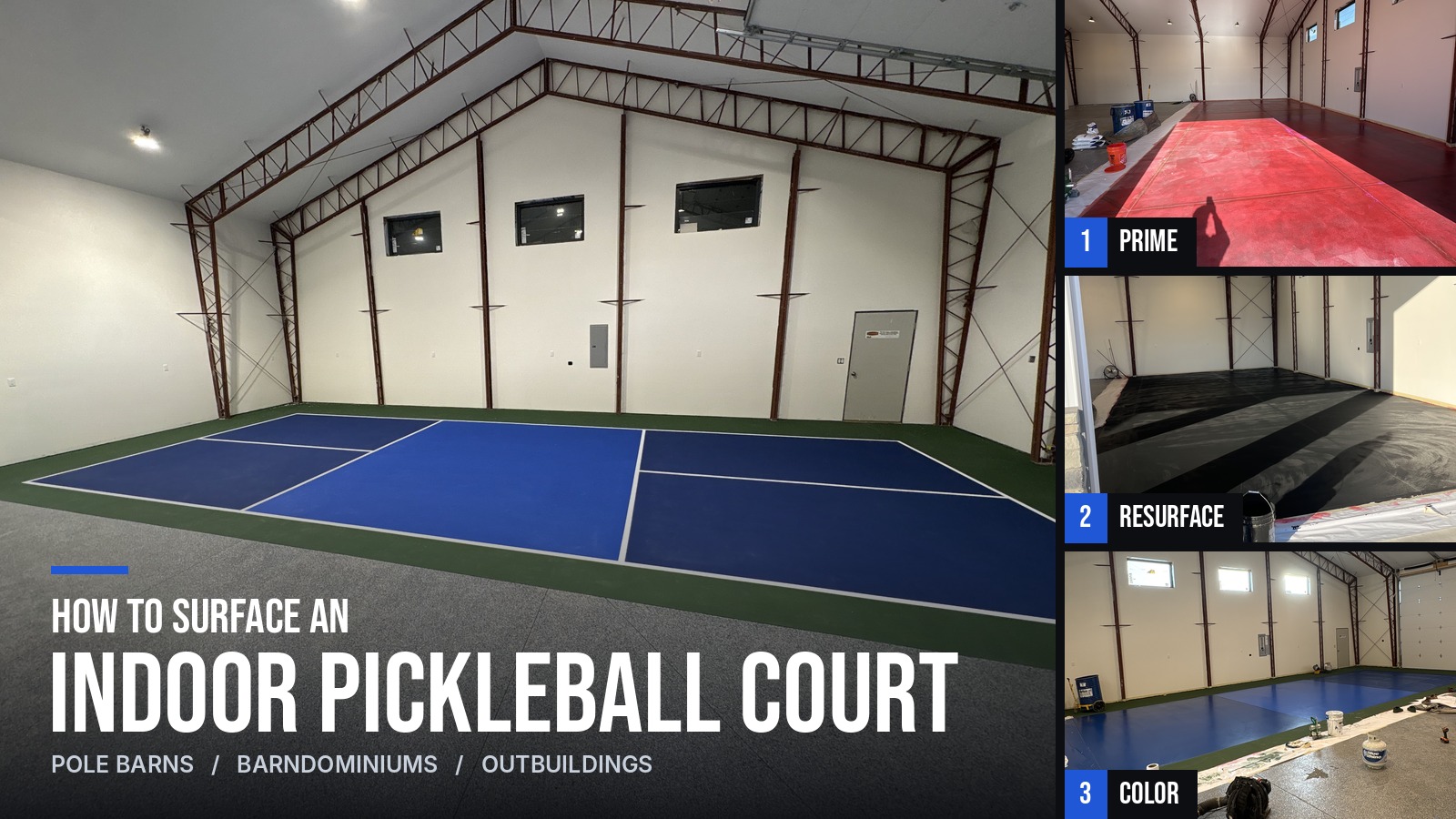
How to Surface an Indoor Pickleball Court in a Pole Barn, Barndominium, or Outbuilding
Outdoor court season in the Midwest ends when the temperature drops. Indoor court season is in full swing.
If you have a pole barn, barndominium, shop, or outbuilding with a concrete floor, you already own most of an indoor pickleball court.
What’s missing is a real playing surface.
Here is how we surface indoor pickleball courts at Endurance Courts, what your building needs before we show up, and what changes when the work happens in January instead of July.
Can You Put a Pickleball Court in a Pole Barn or Barndominium?
Yes, if the building has enough open floor and the slab is in decent shape.
A pickleball court’s lines measure 20′ x 44′. That is the playing area, and you’ll need additional room for the out of bounds.
We recommend 30′ x 60′ of clear floor for one indoor pickleball court. That gives you 8 feet behind each baseline and 5 feet on each side. A 40′ x 60′ pole barn handles one court comfortably. A 34′ x 64′ court is competition size, and it’s usually more than a private court needs.
30′ x 50′ is tight. It leaves 3 feet behind each baseline. If that’s the space you have, we can lay out a recreational-sized pickleball court to fit.
If you want pickleball and basketball in the same building, a 30′ x 60′ court fits pickleball with a half court of basketball striped in.
How Tall Does the Ceiling Need to Be for Indoor Pickleball?
Industry guidance for new indoor pickleball construction recommends about 18 feet of clear height. Plenty of pole barns and barndominium shops have 12 to 16 foot sidewalls. Those still make good private courts, especially if it’s more for recreational play.
If you are still in the planning stage, go taller and keep the court area clear span. No interior posts inside the 30′ x 60′.
For lighting, use LED fixtures and mount them along the sides of the court instead of directly over it. Low fixtures straight overhead are the biggest source of glare complaints indoors.
What Kind of Concrete Slab Does an Indoor Pickleball Court Need?
The surface is only as good as the concrete under it. If you are pouring a new pole barn or barndominium floor, tell your concrete contractor it is going to be a court before they pour.
Here is what we look for:
- A vapor barrier under the slab. Two layers of 6 mil is ideal, and acrylic manufacturers require one.
- Cure time. We typically wait 45 days for it to cure fully before surfacing.
- A medium broom finish. Most shop floors get power troweled smooth, which is great for sweeping and bad for coating adhesion.
- No curing compounds or sealers. They act as a bond breaker between the concrete and the court surface.
- A minimum 5 inch slab, with as few low spots as possible.
Rebar is fine for an indoor court. Outdoors, we usually recommend post-tension.
Can You Surface an Existing Shop, Barn, or Garage Floor?
Yes. Most of the indoor courts we surface are existing slabs.
If the floor is troweled smooth or has been sealed, we grind it to open up the concrete so the coating can bond. Oil spots from the years it spent as a shop get cleaned and treated before we start.
Control joints are fine. Most slabs have them, and we fill them as part of the process.
Not sure what’s under your slab? Tell us when it was poured and we’ll talk through it.
What Is the Best Surface for an Indoor Pickleball Court?
Acrylic court surfacing over concrete. It is the same system used on outdoor courts and tournament courts.
This means your indoor court plays the same as the outdoor court you use the other eight months of the year.
Acrylic gives you a true bounce, a textured surface with real traction, and color.
The alternatives:
- Bare concrete with painted lines. It is slick, dusty, and hard on your knees and the ball. It is also still a garage floor.
- Garage floor epoxy. We can still stripe your epoxy floor, but it might be slippery.
- Snap-together modular tile. We don’t carry or install it.
How Do You Surface an Indoor Pickleball Court, Step by Step?
This is the process we just ran on an indoor court in Elgin, on an existing slab inside a building with no heat hooked up yet.
- Prep the concrete. We grind or acid etch the slab, depending on its finish.
- Fill the control joints. We spread Type S mortar mix dry into every saw-cut joint, scrape off the excess, then soak it with acrylic patch binder. The mix settles as it absorbs.
- Prime. One heavy coat of concrete primer, rolled on. Then we wait 2 to 3 hours, because the primer has to be fully dry.
- Acrylic resurfacer. Two coats. The first carries a heavier sand load to smooth out the surface.
- Color coats. Two coats in the colors you pick.
- Lines. Taped, sealed, primed, and painted. Pickleball lines are standard, and basketball lines can go down at the same time.
- Net. Surface-mounted posts or a movable net system.
By the third or fourth coat, the control joints disappear. The floor stops looking like a shop and starts looking like a court.
From the resurfacer coat on, the steps are the same as an outdoor court. The difference indoors is everything happening in the air around it.
Can You Surface an Indoor Pickleball Court in the Winter?
Yes, but the building has to be warm enough for the paint to cure.
Acrylic court coatings are water based. They cure when the water evaporates out of them.
Outdoors, sun and wind do that work, and a coat dries in 1 to 3 hours. Indoors, plan on 4 to 6 hours per coat. Manufacturer specs for indoor work call for steady heat and good ventilation, and some recommend one coat per day.
Four things control how fast an indoor court gets done:
- Temperature. We want the room between 72 and 80 degrees, and warmer is better. Manufacturer specs set 70 degrees as the floor for indoor application.
- Ventilation. Moving air carries the moisture out. That means fans running and a door or window cracked, even in January.
- Humidity. Heat plus evaporating water raises the humidity in a closed building, so sometimes a dehumidifier runs the whole job.
- The right heaters. If the building has no HVAC, we bring propane heaters and build that into the quote.
How Long Does It Take to Surface an Indoor Pickleball Court?
In a climate-controlled building, we have surfaced an indoor court in about a day and a half. In an unheated building in winter, expect roughly double.
We’ll reach out ahead of time so you can have the heat on before our crew arrives.
If your barndominium is still under construction, schedule the court after the HVAC is live and before the furniture, the boat, and the side-by-side move in.
How Much Does It Cost to Surface an Indoor Pickleball Court?
It depends on five things:
- Square footage of the court area
- Slab prep, including grinding, joint filling, and low spots
- Heat. An unheated building in winter adds labor days and equipment
- Lines and sports. Pickleball only, or pickleball plus basketball
- Net system and travel distance
Reach out and we’ll provide an accurate quote.
What Should You Have Ready Before You Call an Indoor Court Contractor?
We can usually quote an indoor court from photos and a few answers:
- Interior dimensions of the building and the clear height to the trusses
- When the slab was poured
- Whether the floor is broom finished, troweled smooth, or sealed
- Photos of the floor, the control joints, and any stains or cracks
- What heat the building has, if any
- Which sports you want lines for
- When you want to be playing
How Do You Get on the Winter Schedule?
Indoor court surfacing is what we do from November through March, and we travel across the Midwest for it. Call 402-590-5600 or email build@endurancecourts.com to get started.
Your pole barn is already storing things you don’t use. It may as well hold a pickleball court.


Leave a Reply