
What Should a Tennis Court Resurfacing or Pickleball Conversion RFP Include?
If you manage tennis courts for a city, school, HOA or club, chances are you’re in the process of deciding next year’s work. It may include the question every parks board is hearing right now: can we add pickleball?
The problem is writing a complete spec for what you’re looking for can be challenging since you don’t do this regularly.
A vague spec gets you bids you can’t compare. One contractor prices two coats of resurfacer, another prices one, a third prices “resurface court” and nothing else. The low number usually wins, until you find out a year later that they were the lowest bid for a reason.
This post walks through what we think belongs in a court surfacing spec or RFP, based on the bids, site walks and change orders we’ve been working through this fall. Take whatever is useful. We won’t be offended.
Why Should You Write Your Court Spec in November?
Acrylic court coatings need warm, dry weather to cure. In most of the Midwest that means nobody is surfacing an outdoor court until spring. Writing the spec now gets you ahead of the rush.
- You get on the schedule early. Spring fills up fast. The owners who bid in January get the April and May slots. The ones who bid in April get August.
- Your budget and your spec line up. If your money comes out of this fiscal year, confirm the purchase order carries over before the work slips into next year. A PO reserves the funds.
- Contractors have time to actually walk your courts. In the middle of the season many court contractors are busy so now is the time to truly inspect the court and have priority assessments.
If you’re a public owner, check your bid threshold too. A project that lands just under the limit can move a lot faster than one that has to go out for formal public bid. Just make sure the scope is honest and not trimmed to fit a number.
What Should Your Spec Say About Cleaning and Surface Prep?
Prep decides how long the new surface lasts. Coatings don’t bond to dirt, algae or loose old material, so this is the part a low bid usually shortchanges. Spell it out step by step:
- Clean the full surface. A rotary surface cleaner, then power washing with a cleaning agent to break down mildew and organic staining. We power wash twice.
- Flood the court. Flooding shows every low spot and “birdbath” where water sits. The common industry test is whether standing water is deeper than a nickel after the court has had time to drain.
- Level the low spots. Patch and level with a court patch binder, not a general-purpose concrete patch.
- Flood it again. Confirm the repairs worked before anything else goes down.
- For new or bare concrete, require an etch or profile. Acid etch or grind so the primer has something to adhere to. Smooth, troweled concrete is great for a garage floor and terrible for coating adhesion.
- Require proper cure time on new slabs. New concrete needs to cure before it gets coated so put that minimum (we recommend 45 days) in writing.
How Should an RFP Handle Cracks?
Most court cracks are not a coating problem. They’re a slab problem showing through the coating.
Ask every bidder to tell you what kind of cracks you have and what they plan to do about them. Hairline surface cracks can be filled and sealed. Structural cracks running through an old asphalt base will keep coming back no matter how well the surfacing is done. We’ve walked courts this year that were resurfaced a year earlier and already cracked and spongy again. That’s a perfect example of a slab near the ends of it’s useful life.
What to put in the spec:
- Require bidders to identify crack type and say whether their repair is cosmetic or structural.
- Name the crack repair method. Fill, a crack repair system, or full slab replacement. These are very different prices for very different results.
- Include a re-cracking note. Some cracks returning on an older slab is expected. Make sure to put that in writing.
If a bidder promises your 25-year-old cracked court will never crack again, ask them to put it in the warranty.
What Should the Spec Say About Moisture and Vapor Barriers?
Moisture coming up from under a slab is one of the most common reasons acrylic surfacing bubbles, delaminates or goes soft. A lot of older courts, and plenty of newer residential slabs, were poured without a vapor barrier.
Signs you have a moisture problem: plants growing out of cracks, spongy spots, peeling or blistering in patches, or areas that stay dark long after rain.
- For new construction, spec a vapor barrier under the slab. Don’t assume the concrete contractor includes one.
- For existing slabs without one, ask bidders whether they recommend a topside moisture barrier and price it as its own line.
- For indoor courts, include the building’s heating and humidity conditions. Coatings care about the air, not just the slab.
How Many Coats Should Be in Your Court Surfacing Spec?
This is where bids get quietly different. “Acrylic surfacing” can mean four coats or six. Write the system out so every bidder prices the same thing. A standard acrylic system looks like this:
- Primer, on concrete
- Acrylic resurfacer, 2 coats
- Acrylic color coat, 2 coats
- Line primer, 1 coat
- Line paint, 2 coats
A few more things worth putting in writing:
- Name the product line or “approved equal.” Then require the bidder to submit the manufacturer’s product data and application instructions with their bid.
- Ask about sand in the mix. The sand in the color coats controls ball speed. More sand plays slower, less plays faster.
- Require application per the manufacturer’s spec, including minimum temperatures and dry times between coats.
How Do You Spec a Tennis to Pickleball Conversion?
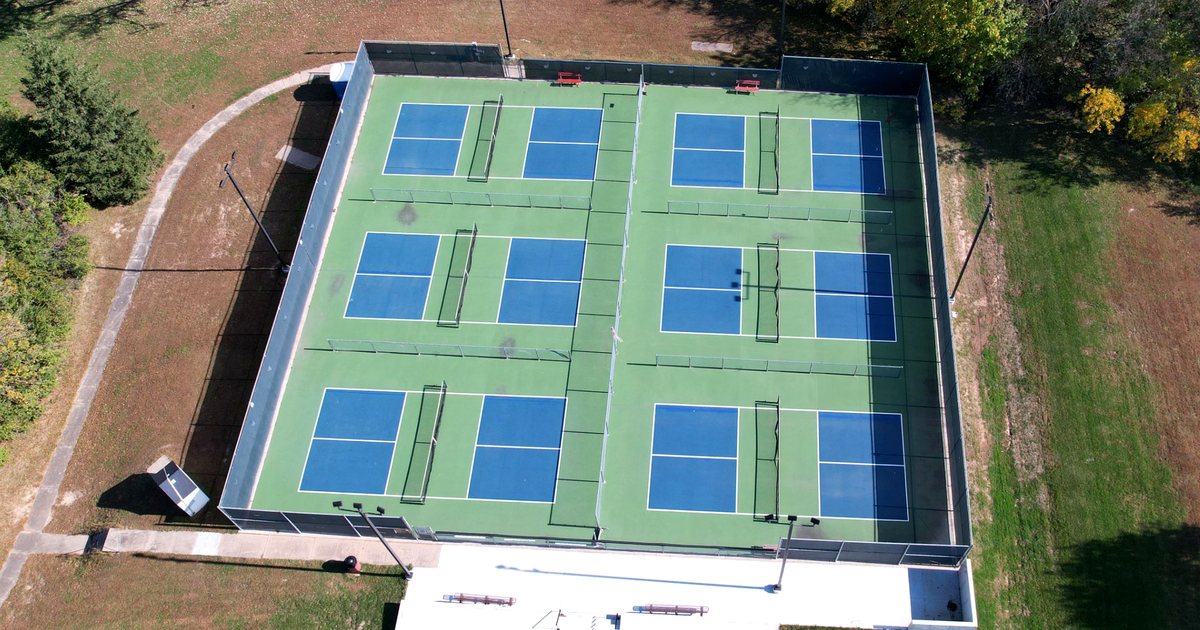
Most pickleball projects we bid aren’t new courts. They’re tennis courts being converted into pickleball. A conversion can be a great use of an existing slab, but only if the spec answers a few questions before bidders start guessing.
Decide: dedicated, blended, or a mix?
- Dedicated pickleball. One standard 60′ x 120′ tennis enclosure fits four pickleball courts. Tennis goes away on that court. Best for clubs and parks where pickleball demand is high.
- Blended lines. Tennis and pickleball lines on the same court, usually in different colors. Cheapest option, keeps both sports, but the extra lines can bother players of both. (Net height is different between the sports and tennis usually wins out.)
- A mix. On a multi-court battery, keep some courts tennis and convert others. We recently reconfigured four tennis courts into two tennis and four pickleball, which kept the tennis players and the pickleball players from fighting over the same court. Mostly.
What the spec needs to say:
- The layout. How many pickleball courts, where they sit, and whether tennis lines stay. Ask bidders for a drawn layout with dimensions.
- Old line removal. Old tennis lines don’t disappear under new color. They telegraph through as ghost lines. Spec grinding or covering them, then leveling any depressions the grinding leaves.
- Colors that help players read the court. A different color for the pickleball playing area and the kitchen makes the right lines easy to find, especially on blended courts.
- Nets and posts. Pickleball nets sit lower than tennis nets, so the tennis net can’t just stay. Spec in-ground or surface-mounted posts. On public courts, skip portable nets. They walk away.
- Dividers and fencing. Four pickleball courts in one enclosure means balls rolling into the next game. Spec divider netting or fencing between courts if you want fewer interruptions.
- Grant requirements. If you’re counting on a USTA or other grant, check whether your line plan affects eligibility before you write the spec around the money.
And the big one: a conversion is still a resurfacing job. Everything above about cracks, moisture and coat count still applies. New lines on a failing slab are just a nicer-looking failing slab.
What Should You Specify for Lines, Colors and Nets?
List exactly which lines you want, because “stripe the court” means nothing.
- Line sets: tennis only, pickleball only, or blended tennis and pickleball. Same for basketball: high school or college three-point line, lane width, free throw line.
- Colors by name: court interior, kitchen, and outside apron. Name the product colors so the court you approve is the court you get.
- Line method: Ask how they get clean edges. Our method is taping, rolling over the tape multiple times to seal it, then line primer and two coats of line paint. Fuzzy lines aren’t usually a short cut being taken somewhere.
- Net posts and foundations: Old posts that lean or heave usually need new footings, not just new nets. Spec the post system (in-ground or surface-mounted) and whether foundations are included.
What Warranty Should You Ask For?
Ask for a written workmanship and materials warranty, and read the exclusions. A realistic resurfacing warranty covers the work and the materials for a set period. It won’t cover the slab underneath, moisture from below, or cracks that were already there.
Nobody can warranty a base they didn’t build. Be wary of a bid that seems to cover everything, especially if it’s also the cheapest one.
How Do You Set Up Payment Terms and the Bid Form?
A clear bid form makes bids comparable. A clear payment section keeps the end of the job from turning into an accounting puzzle.
- Use a bid form with line items for each scope piece: prep, crack repair, moisture barrier, surfacing, striping, posts and nets. Then add alternates for anything you might cut.
- Make the site visit mandatory. Bids from photos miss birdbaths, heaving posts and existing hoops. We measure and account for these on every site visit.
- Say who gets invoiced. The legal entity name and address, not a board member’s personal name.
- Spell out retainage and timing. For example, a percentage held until final completion, and how items installed later (like a spring add-on) get billed.
- Note hard deadlines. If you need proof of payment by a certain date to close out a grant or budget year, say so up front.
- List bonding and insurance requirements, and let bidders show bond cost as its own line.
Want Help Writing Your Court Spec This Winter?
A good spec doesn’t have to be long. It has to be specific enough that every bidder is pricing the same court. If you write down the prep, the crack plan, the moisture plan, the coat count, the lines and the warranty you expect, the lowest bid actually means something.
Endurance Courts builds and resurfaces pickleball, tennis, basketball and multi-sport courts for parks departments, schools, HOAs, developers and homeowners.
We’re happy to walk your courts, tell you honestly what we see, and help you put together a scope you can bid out in the spring. Even if we don’t end up being the ones who build it.
Call 402-590-5600 or email build@endurancecourts.com.


Leave a Reply