
How High Should Tennis and Pickleball Net Posts Be?
Tennis net posts should hold the net cord at 42 inches (3’6″) with the center strapped down to 36 inches. Pickleball nets should be 36 inches at the sidelines and 34 inches at the center. Remembering those is easy, but rarely is it something we find when inspecting courts.
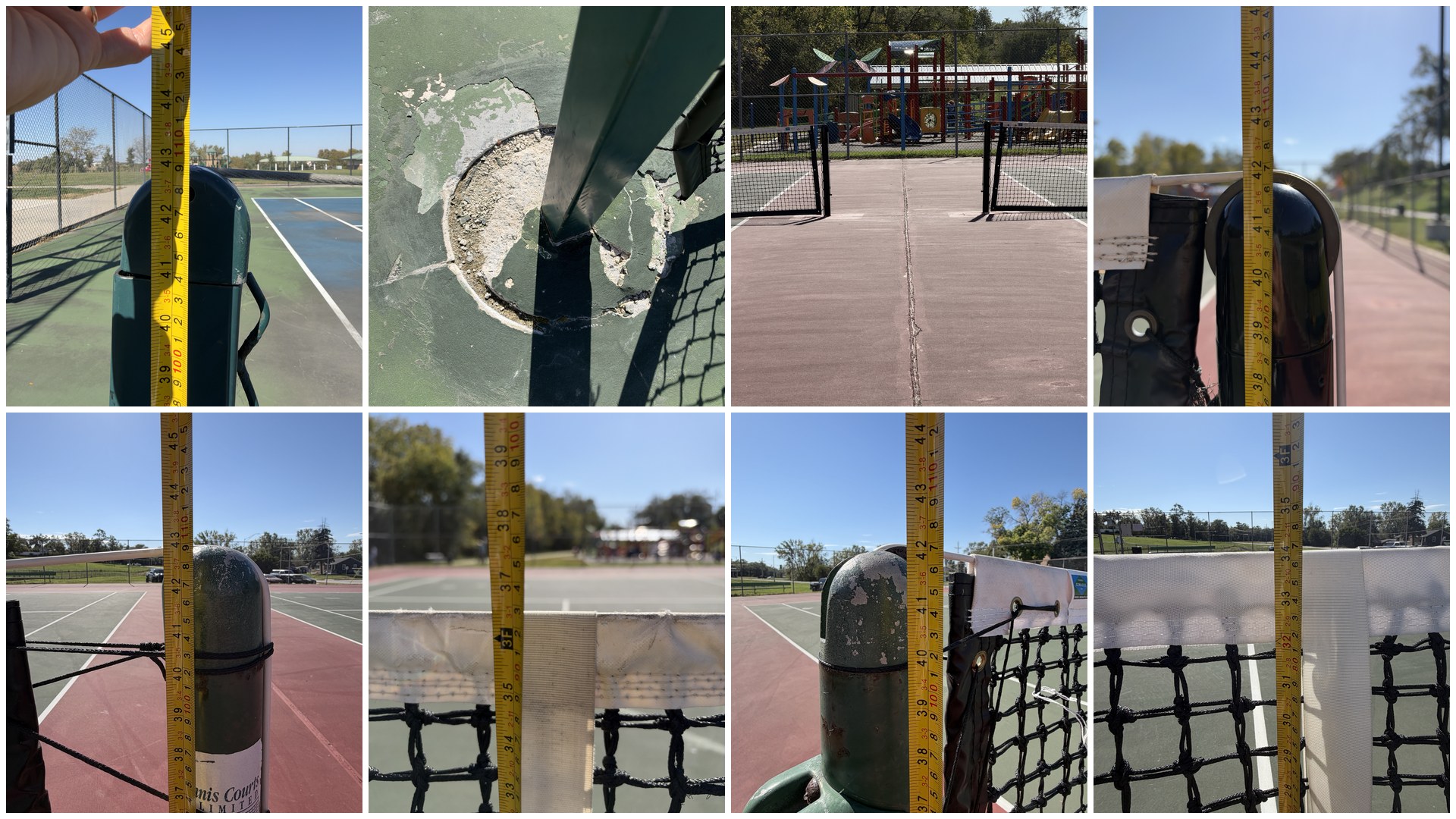
Yesterday we evaluated 15 courts. Every one of them got a tape measurement on every post and every center strap. We documented each measurement so we know how to propose the entire restoration of the court, not just the surfacing. Net height makes a huge difference for anyone playing and is often overlooked during tennis court inspections.
Here’s what the specs say, how we measure, and why courts can get misaligned in height over time.
What Is the Correct Net Height for Tennis?
Under the ITF Rules of Tennis (which USTA follows), the net cord sits at 3’6″ (42 inches) at the posts and 3’0″ (36 inches) at the center. The center height is held by a center strap anchored to the court. Here are the things we check during an inspection:
- Post location: the center of each post sits 3 feet outside the doubles sideline. Posts set closer than that change the net’s sag and the height at the sidelines.
- Top of post: no more than 1 inch above the top of the net cord. A post that sticks up 3 inches past the cord usually means the reel or cable hardware was swapped and nobody adjusted for it.
- Post size: no more than 6 inches square or 6 inches in diameter.
- Center strap: completely white and no wider than 2 inches.
The 42-to-36 drop is not a straight line. The net sags in a curve, so the height at the doubles sideline and the service line is somewhere in between and depends on cable tension. That’s one more reason the post and strap numbers have to be right.
What Is the Correct Net Height for Pickleball?
USA Pickleball’s rulebook sets the net at 36 inches at the sidelines and 34 inches at the center. Posts go outside the sideline, with 12 inches outside the sideline as the recommended spot. A center strap is allowed to hold the middle at 34.
Notice the measuring points are different from tennis. Tennis measures at the posts. Pickleball measures at the sidelines. If your pickleball posts are 12 inches out, the post height itself will read a hair over 36 once the net sags in toward the sideline. That’s normal. What we care about is 36 at the line and 34 at the middle.
Two inches of drop doesn’t sound like much. But on a competitive game of pickleball it can make a huge difference.
Can You Play Pickleball on a Tennis Net?
You can, however, it just won’t be a pickleball net. A properly set tennis net is 36 inches at the center, which is 2 inches high for pickleball. Out at the pickleball sideline, roughly 10 feet from center, the tennis net is still climbing toward its 42-inch posts, so it reads higher than 36 there too.
The usual workarounds, and what we see happen with each:
- Crank the center strap down to 34. Works for pickleball. Then the next tennis player shows up to a net that’s 2 inches low, and nobody ever cranks it back. This is one of the most common findings on our evaluations.
- Portable pickleball nets on the tennis court. Fine for casual play. They grow legs at public parks, and the center bar on cheaper models sags below 34 over time.
- Dedicated pickleball posts in their own sleeves or footings. The right answer for any court that’s really a pickleball court now.
If a court is blended tennis and pickleball, parks and rec departments usually opt for tennis height nets.
How Do We Measure Net Posts and Center Straps?
A tape measure is a simple tool. Using it right on a net takes a little more thought. On every court we evaluate:
- Leave the net at playing tension. Measuring a slack net or one somebody just over-cranked tells you nothing about how it plays.
- Measure to the top of the net cord or cable, not the post cap. The cap is decoration. The cord is what the ball has to clear.
- Start the tape on the playing surface, not the low spot. Surface around old footings is often heaved, cracked, or sunken. We read from the plane of the court, not on the post footings (unless it’s the same).
- Measure the center at the strap, to the top of the white band. Then we check that the strap is actually anchored and adjustable.
- Check the extras. Is the post plumb? Is the cap more than 1 inch over the cord? Does the reel turn, or is it rusted in place? Is the footing cracking the surface around it?
“Looks fine” isn’t a measurement, and it has a way of turning into a resurfacing bid that didn’t account for four new post foundations.
Why Do Net Posts Drift Out of Spec?
Almost every post we’ve measured was set correctly on day one. Then it met Midwest weather.
- Frost heave. Water gets into cracks around the footing, freezes, and pushes the footing up. A post that heaves an inch reads an inch high. Uneven heave tilts it. Once the surfacing breaks up in a ring around the post, water gets in faster and the cycle speeds up.
- Cable tension. A net reel is a lever. Crank it hard enough, long enough, and it pulls the tops of the posts toward each other. A leaning post drops the cord height and puts constant stress on the footing.
- Shallow or undersized footings. Older courts and some newer budget jobs set posts in footings that were never deep enough to stay put through freeze-thaw. These are the ones that continually move year after year.
- Rusted sleeves and hardware. Posts that sit in sleeves can rust in place or wobble loose. Replacement posts, reels, or caps that don’t match the original setup change where the cord sits.
- Resurfacing. Every new coating system adds a little thickness. Not much per job, but courts that have been resurfaced several times without anyone checking the posts can creep low.
A post that’s out of spec because of hardware is a cheap fix. A post that’s out of spec because the footing moved usually means new foundations. That’s why we look at the surface around the post as closely as the post itself.
What Goes Wrong With Center Straps?
The center strap is the cheapest part of the whole net system and the one most likely to get off kilter. What we run into:
- Adjusted for the wrong sport. Pulled to 34 for pickleball on a tennis court, or left at 36 on a court that’s mostly pickleball now.
- Stretched or frayed straps. Webbing stretches over a few seasons. Set to 36 in April, reading 36 and a half by August.
- Missing or broken anchors. The anchor gets pried loose, covered over during a resurfacing, or snapped off. Then the strap gets tied to a hinge, a brick, or nothing at all.
- No strap, period. Some nets just hang. Without a strap, the center height depends entirely on cable tension.
If the anchor is gone, we note it, because a new strap clipped to nothing will be wrong again by next week.
What Are the Numbers to Remember?
| Tennis | Pickleball | |
|---|---|---|
| Height at posts / sidelines | 42″ (3’6″) at posts | 36″ at sidelines |
| Height at center | 36″ (3’0″) | 34″ |
| Post location | Center of post 3′ outside doubles sideline | Outside sideline, 12″ recommended |
| Center strap | White, max 2″ wide | Allowed, holds center at 34″ |
Want Your Courts Checked?
Endurance Courts measures every post and every center strap on every court we evaluate, along with cracks, drainage, surface condition, and footings. If you manage park, school, HOA, or club courts in Nebraska or Iowa, we’re happy to evaluate and report our findings.
Call 402-590-5600 or email build@endurancecourts.com to get started.


Leave a Reply