


How Much Does a Pickleball Court Cost in Nebraska?
If you’re a Nebraska homeowner looking to build a backyard pickleball court, here’s the honest answer most contractors won’t give you upfront: expect to spend between $30,000 and $50,000- and the biggest variable has nothing to do with the court itself. It has to do with your backyard.
Here’s a complete breakdown of what drives pickleball court costs in the Omaha area, what’s worth spending money on, and what you can skip depending on how you plan to use it.
The Baseline: What a $30,000 Pickleball Court Gets You
A bare-bones residential pickleball court in Nebraska — standard 30′ x 60′ dimensions, properly installed on a concrete slab, with basic line striping — will typically start around $30,000.
At this price point, you’re getting a functional, durable court. What you’re not getting is surface coating, fencing, lighting, or accessories. It’s a solid foundation, but most homeowners who build at this level end up wishing they’d added a few key upgrades from the start.
The bulk of that cost, anywhere from 50% to 75% of the total project, is in the concrete work. That surprises most people. They assume the surface or the accessories are the expensive part. They’re not. Concrete is.
Why Concrete Is So Expensive (And Why Slope Changes Everything)
The single biggest variable in any court build is the condition of your backyard. Specifically, how level it is and what’s happening with water drainage.
When we walk a property for the first time, one of the first things we’re assessing is slope. A backyard that sits at the bottom of a grade, or one with uneven terrain across the court footprint, requires significantly more prep work before a single yard of concrete is poured.
What does that prep work actually involve? Depending on the site, it can include:
- Grading and excavation to create a level surface
- Retaining walls to contain the court perimeter and prevent soil movement over time
- French drains to redirect water away from beneath the slab
- Deeper aggregate base — in Omaha, we typically install a 4–8″ compacted crushed rock sub-base to handle Nebraska’s freeze-thaw cycles. Without it, the ground heaves in winter, and the slab cracks.
- Rebar reinforcement — steel rebar is embedded throughout the concrete slab to minimize cracking and resist movement over time. This is a structural decision, not an aesthetic one. A slab without rebar is far more vulnerable to shifting soil and temperature stress Vapor barrier — a plastic sheeting layer installed beneath the slab to prevent ground moisture from rising up through the concrete. Without it, moisture migrating up from below can compromise the bond of your surface coating and shorten the life of the entire court
A flat, well-drained backyard with easy access can keep your concrete costs toward the lower end. A sloped lot with drainage challenges can push those costs significantly higher and there’s really no way around it if you want a court that holds up for 20 years.
This is why getting an on-site assessment matters so much. A quote over the phone or based on square footage alone won’t account for any of this.
What Takes a Court from $25,000 to $50,000
The upgrade decisions that move a project toward the higher end of the range are worth understanding, because some of them make a much bigger difference than others in day-to-day enjoyment of the court.
Sports Surface Coating- The Upgrade We Recommend to Almost Everyone
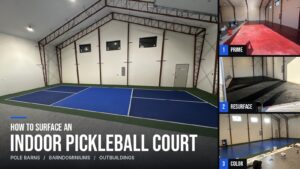
Most people assume that once the concrete is poured, the court is ready to play on. While technically you could, here’s the upgrade that few court contractors in Omaha can do well: Surface Coating.
Bare concrete is functional, but it has joint lines that affect ball bounce, and it’s unforgiving underfoot. A proper sports surface coating fixes both of those things.
Here’s what the process actually involves when done right:
- 45-day curing period — concrete needs to fully cure before any coating is applied. Rushing this step causes the surface to fail prematurely.
- Acid wash — removes impurities and opens the surface pores so the coating bonds and adheres properly.
- Moisture test — if moisture levels are too high, the coating won’t adhere correctly and can cause hydrostatic pressure.
- Acrylic base coat — the first layer, which fills surface imperfections and smooths out joint lines.
- Two coats of USTA-grade acrylic paint — the finish coats that give you the color, texture, and performance of a professional pickleball surface.
This isn’t a weekend DIY project, and it’s not something you want cut corners on. When it’s done correctly, the surface plays better, looks better, and protects the concrete underneath. It’s one of the most worthwhile investments in the whole project.
Lighting- Plan for It Before You Pour
Court lighting is one of those upgrades homeowners wish they’d planned for from the start. Once the slab is poured and the landscaping is done, adding hardwired lighting becomes a much more complicated and expensive retrofit.
For a standard pickleball court, you’ll want at minimum two lights positioned in the center of the court to eliminate shadows and allow for evening play. Solar-powered options get a lot of marketing attention, but for consistent, reliable performance, hardwired electrical is the right choice.
The key takeaway: if you think you might want lighting someday, tell your builder before the concrete goes in. Conduit needs to be run beneath the slab and through the yard. Doing it after the fact means cutting into finished work.
Fencing- Necessary for Pickleball, Optional for Basketball
Whether you need fencing depends largely on what sport you’re building for.
For a pickleball or tennis court, fencing is essentially mandatory. Without it, you’ll be chasing balls constantly. Pickleball in particular generates a lot of errant shots that travel fast and far.
For a basketball shooting pad or half court, fencing is optional. Many families skip it entirely and have no issues.
When fencing is appropriate, the recommended height for full coverage on a pickleball court is 8–10 feet along the baselines and sides. One way to manage cost is to use a shorter 4-foot fence at the side entrances, reserving the full-height fencing for the areas where balls are most likely to escape.
Other Upgrades to Factor In
- Basketball hoop — if you’re building a multi-use court, a quality in-ground hoop is typically included in the upper price range
- Custom line striping — multiple sports can be painted on a single surface in different colors (pickleball, basketball, and volleyball lines can all coexist)
- Containment netting — an alternative or supplement to fencing in some configurations
Quick Cost Summary
| Configuration | Estimated Range |
|---|---|
| Bare concrete court, basic striping | $30,000 |
| Concrete + sports surface coating | $34,000–$38,000 |
| Concrete + coating + fencing | $34,000–$45,000 |
| Full build with lighting, fencing, hoop, custom striping | $45,000–$60,000+ |
Note: These ranges reflect typical Omaha-area residential projects. Significant slope, drainage challenges, or retaining wall requirements can push costs higher regardless of surface and accessory choices.
What to Do Before You Call for a Quote
A few things that will make your first conversation with any court builder more productive:
- Know your backyard dimensions — a rough measurement of the area you’re considering is helpful
- Take note of the slope — walk the yard and pay attention to where water flows after rain
- Think through how you’ll use it — Pickleball only? Basketball too? Evening play? This shapes the whole project
- Have a realistic budget conversation with yourself — the $30,000–$50,000 range is real, and knowing which end you’re working toward helps your builder design the right solution
Ready to Get a Real Number for Your Backyard?
Every yard is different, and the only way to get an accurate quote is to see the site. At Endurance Courts, we offer on-site assessments for homeowners in the Omaha area and give you a straight answer on what your project will actually cost. Ready to get started on a backyard sports court? Reach out to get a quote →
Endurance Courts builds residential pickleball courts, basketball courts, and multi-use courts in Omaha, NE and surrounding areas.


Leave a Reply