

Resurface or Rebuild? How to Know When Your Court Is Too Far Gone
If your tennis, pickleball, or basketball court is cracked, faded, or holding water, it’s easy to assume the solution is resurfacing.
Sometimes it is.
Other times, resurfacing a failing court is little more than putting a Band-Aid over a structural problem.
At Endurance Courts, one of the first questions we ask when someone tells us their court needs resurfacing is simple:
What makes you think it needs to be resurfaced?
Before recommending a solution, we want to understand why the surface is failing. That usually requires an on-site assessment of the cracks, low spots, drainage, existing coatings, and overall condition of the court.
Here’s what we’re looking for.
Start With the Cracks
Cracks are one of the best clues we have about the health of an existing court.
But not all cracks are equal.
We look at the width and depth of the cracks, whether one side is higher than the other (vertical displacement), and whether there is evidence of movement underneath the slab.
Small hairline cracks, generally less than about 1/4 inch, can often be filled and rehabilitated as part of the resurfacing process.
Large cracks are different.
When cracks become wide, deep, uneven, or widespread throughout the court, they can indicate structural failure underneath the playing surface. We can fill a large crack. In some cases, we can even reinforce the repair with fiberglass membrane and adhesive before applying the new surfacing system.
But that doesn’t mean we’ve solved what caused the crack. If the slab or base underneath it continues moving, the crack can eventually return.
That’s when crack repair starts becoming a Band-Aid rather than a permanent solution.
Next, Look for Birdbaths and Low Spots
The next thing we assess is how well the court drains.
Ideally, we like seeing a court after it rains because standing water makes low areas immediately obvious.
But we don’t necessarily need rain to find them.
One trick is looking at where dirt, dust, and debris accumulate. Water naturally carries debris toward low areas as it moves across the court, so those patterns can reveal where water has been collecting even when the court is dry.
Minor depressions can often be leveled as part of resurfacing.
Significant settlement is another story.
As a rough field reference, think about the thickness of a nickel. A relatively shallow low spot may be something we can correct. If we’re looking at depressions two or three nickels deep, or areas requiring significant amounts of leveling material—we start asking why that section of the court sank in the first place.
We can potentially level it, but we can’t stop it from continuing to sink.
What Causes a Tennis Court to Fail?
A lot of surface problems don’t actually begin at the surface, it all starts underneath.
Poor base preparation and drainage are two of the biggest problems we encounter.
If the ground wasn’t properly prepared and compacted before the court was constructed, movement underneath the slab can eventually translate into cracking, heaving, and settlement above it.
Vegetation growing through cracks can be another warning sign.
When we see plants coming through a court, it can indicate that moisture and organic material are making their way up from below and that the original construction may not have included an adequate vapor barrier (or a vapor barrier at all)!
A properly constructed court should have a well-compacted sub-base, appropriate crushed aggregate, vapor barriers, proper drainage, and a slab designed for longevity.
You can’t eliminate every variable in the soil underneath a court, but good construction dramatically reduces the opportunity for soil movement and structural problems down the road.
Resurfacing Isn’t Just Putting New Paint Down
If we determine the structure is in reasonable condition, then we start developing the resurfacing scope.
And that scope can vary dramatically from court to court.
A relatively healthy slab with minor hairline cracking might require us to power wash and clean the court, mechanically buff the surface, repair cracks, level low spots, apply primer and acrylic resurfacer, apply two coats of color, and finish with line striping.
Other courts require considerably more preparation. If cracks are significant enough, they may need to be filled and reinforced before resurfacing.
We’ve also encountered courts where previous repairs actually created new problems.
On one concrete court we inspected, the previous tennis lines had been removed by grinding them off. That left intentional depressions running throughout the court everywhere the old lines had been.
Before that court can be resurfaced properly, those areas need to be leveled.
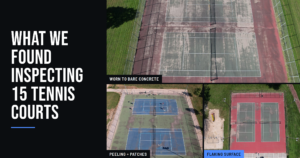
On another court, the existing coating itself may be failing. If the old paint or surfacing material is cracking, peeling, or no longer properly bonded to the substrate, putting another coating over it won’t fix the problem.
In those situations, we may need to mechanically grind off the failing material, blow and clean the entire surface, and get back to a sound substrate before beginning the resurfacing system.
That’s why two courts of exactly the same size can have very different resurfacing costs.
You’re not just paying for what goes on top of the court. You’re paying for everything required to make the surface underneath it ready to accept the new system.
When Does Rebuilding Make More Sense?
There’s no single crack width or number of birdbaths that automatically means a court needs to be demolished.
We look at the entire court.
When we see systematic failure—significant heaving, widespread structural cracking, severe drainage problems, substantial settlement, and vegetation appearing throughout the court—the cost of trying to rehabilitate everything can begin approaching the cost of starting over.
At that point, rebuilding often becomes the better investment.
Why spend a significant amount of money repairing a fundamentally compromised structure when you could put that investment toward a new court you’ll be much happier with long-term?
That doesn’t mean rebuilding is always the answer.
Sometimes Resurfacing a Failing Court Still Makes Sense
This is where the customer’s goals matter.
We’re currently looking at a project where the customer has a budget under $50,000 and wants the court usable this year.
A new court may ultimately be the better long-term solution. But rebuilding means demolition, site preparation, constructing a new slab, and then allowing approximately 45 days for the concrete to cure before applying the acrylic surfacing system.
The customer may not have the budget or the timeline for that.
In a situation like that, resurfacing may still be the right decision- as long as everyone understands what they’re buying.
We can make the repairs to the best of our ability and improve the playability and appearance of the existing court. What we shouldn’t do is pretend that resurfacing eliminates underlying structural problems.
Sometimes the best solution isn’t necessarily the technically perfect solution. It’s the solution that makes the most sense for the owner’s budget, timeline, goals, and expectations.
What Happens When We Rebuild?
If an existing court has reached the end of its useful structural life, rebuilding gives us the opportunity to address the problems from the ground up.
For an Endurance Courts new concrete court, that means demolishing and removing the existing court and assessing the conditions underneath it.
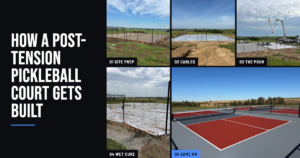
From there, the base is properly prepared and compacted, aggregate is installed, vapor barriers are added, and post-tensioning tendons are installed before the concrete is poured.
Our typical new-court concrete specification is approximately 5 inches of 4,000 PSI concrete with a post-tensioned system.
Instead of continually repairing symptoms caused by the old structure, we’re creating a new foundation designed specifically to support the court.
How Long Should Court Resurfacing Last?
On a structurally sound court, a professionally installed acrylic surfacing system will typically last around four to six years with proper maintenance.
Usage matters and maintenance are key factors here, though.
A competitive facility hosting players every day will naturally experience more wear than a private tennis court used a few times per week.
Standing water, staining, vehicles driving on the court, improper maintenance, and abuse of the surface can all shorten the lifespan of the coating.
There’s another variable that no resurfacing contractor can completely eliminate:
We can’t see everything happening underneath an existing slab.
We can assess the cracking. We can identify settlement. We can look for drainage problems. We can evaluate what the surface is telling us.
But unless we’re tearing the court apart, we don’t know with certainty what’s happening several feet underneath it.
There could be an isolated area of collapsing soil or another subsurface condition that couldn’t reasonably be predicted from a surface inspection.
That’s why there is no responsible way to guarantee exactly how long repairs to a structurally questionable court will last. We can make our best assessment based on what we observe and explain the risks before the work begins.
Resurface or Rebuild? Start With an Assessment
If your court looks worn out, don’t start by asking:
“How much does resurfacing cost?”
Start by asking:
“Why is the condition of my court?”
Once you understand what’s causing the damage, you can make a much better decision about what to do next.
Sometimes the answer is straightforward: repair the cracks, correct the low spots, prepare the surface, and give the court another four to six years of life.
The goal of a good court contractor shouldn’t be to sell you resurfacing or sell you a new court.
It should be to clearly lay out the options so you can decide where your money is best spent.


Leave a Reply