

Why Post-Tension Concrete Is the Lowest-Cost Court Over Its Lifetime
Ask for bids on a pickleball or tennis court and the cheapest number almost always belongs to asphalt. Asphalt really is less expensive to install. So if all you’re comparing is the price on bid day, the decision looks easy.
The problem is that bid day is the one day in a court’s life when asphalt looks good. Spread the cost over the twenty, thirty, or forty years you’ll actually own that court, and the math flips hard.
The cheapest court to build is rarely the cheapest court to own…and on Nebraska soil, the gap is wider than almost anywhere.
Here’s how the real numbers shake out when you look at the long-term cost of ownership.
What Does It Actually Cost to Own a Court for 30 Years?
The install price is just the down payment. The true cost of a court is the sum of four things:
- Construction — what you pay to build it.
- Resurfacing — the acrylic color coat wears and gets refreshed periodically, no matter what’s underneath it.
- Repairs — crack filling, patching, and base work as the structure ages.
- Replacement — what you pay when the foundation finally gives out and you have to tear out and rebuild.
Here’s the key insight most buyers miss: the resurfacing cost is basically the same whether you build on asphalt or concrete, because both get the same acrylic top coat every several years. So resurfacing is a wash.
The entire long-term difference between the two materials comes down to the other two buckets, repairs and replacement, and that’s where asphalt falls short.
Why Does Asphalt Look Cheaper but Cost More?
Asphalt has been the default court base for decades because it’s proven, widely available, and cheaper to install — usually somewhere around 15 to 20 percent less than post-tension concrete. That’s the good news.
The bad news shows up over time. Asphalt is a flexible material, so cracking isn’t a question of if — it’s when. On a road or a parking lot, a crack is no big deal. On a court, a crack is a bad bounce, a tripping hazard, and a liability the owner has to answer for. Builders try to manage it by sawing control joints to steer cracks outside the playing area, but new cracks still find their way into the play surface, and every resurfacing has to deal with them.
And the structure itself has a clock on it. An asphalt court base typically lasts 15 to 20 years before it needs major rehabilitation — and by the 15-year mark, most facility owners are already looking at a full tear-out and rebuild. That’s not a touch-up. That’s paying for a large chunk of your original court a second time.
How Long Does a Post-Tension Concrete Court Actually Last?
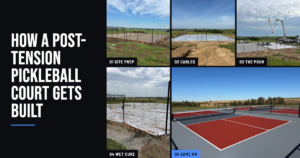
This is where the engineering earns its keep. A post-tension court is a concrete slab reinforced with high-strength steel cables that are tensioned after the concrete cures, putting the entire slab under compression. Because the slab is squeezed together from the inside, it resists the cracking, settling, and soil movement that break down other surfaces.
The result is a court with a life expectancy of at least 25 years, and plenty that are still going strong at 30 to 40-plus.
Just as important, the foundation itself needs virtually no structural maintenance over that span. You’ll still refresh the acrylic top coat every 4 to 6 years (that’s normal upkeep for any hard court) but you’re not chasing structural cracks or budgeting for a base replacement. The court you build today can still be in excellent shape when the kids using it now bring their own kids back to play.
What’s the Real Difference Over the Life of the Court?
Put the two side by side over a 30-year window and the picture gets clear.
The asphalt court wins the install. Then, somewhere around year 15 to 20, it needs a major rehabilitation or a full replacement — so over 30 years, you’re often paying to build the base close to twice. Add in the more frequent crack repair along the way.
The post-tension court costs more on day one. Then it just… keeps working. Same acrylic resurfacing schedule as the asphalt court, but no structural rehab, no replacement.
When you run that out, industry cost analyses have found that asphalt can end up costing tens of thousands of dollars more per court over 30 years than post-tension concrete (one analysis put the gap around $60,000 per court) despite the lower price on bid day. Very few people realize the math down the road.
And for any court that generates revenue or serves a community (a club, a school, an apartment complex, a neighborhood) there’s a fifth “cost” that never shows up on a bid: downtime.
Replacing an asphalt court can take the surface out of play for around 2-3 months. That’s a full season of lost access, lost rentals, and frustrated members, every time the base fails.
Why Does This Matter Even More on Nebraska Soil?
Because our ground is working against asphalt the entire time.
Nebraska is heavy clay, and clay expands and contracts dramatically as moisture changes through the seasons. Layer our freeze-thaw winters on top of that — water seeping into asphalt’s cracks, freezing, and prying them wider. We’ve got a climate practically engineered to age an asphalt court faster than the national averages suggest.
Post-tension concrete is built for exactly this fight.
Because the slab is pre-stressed, it can ride out the soil movement that would crack an ordinary surface, giving you hairline cracks at worst instead of the kind that catch a toe. In a lot of the country the asphalt-versus-concrete debate is close. In eastern Nebraska, the soil tips the lifecycle math decisively toward post-tension.
Who Should Care Most About Lifecycle Cost?
If anyone is thinking of installing a court for the long haul, then the lifecycle cost is important to math upfront.
If you’re a developer or HOA putting a court into a neighborhood, you’re building an amenity that needs to look good and play safe for the decades families live there, without becoming a maintenance line item that homeowners resent.
If you’re a school or facility operator, every replacement is lost programming and lost revenue. If you’re a property manager adding courts to attract and keep tenants, a cracked, patched court does the opposite of what you paid for.
In every one of those cases, the question isn’t “what’s the cheapest court to build?” It’s “what’s the cheapest court to own?”.
The Bottom Line
Asphalt wins the bid and loses the decade. Post-tension concrete costs more up front and then quietly saves you money every year you own it because it requires fewer repairs, no base replacement, less downtime, and far less liability sitting under your players’ feet.
We’re the only company building post-tension pickleball and tennis courts engineered for Nebraska’s soil and meant to last a generation, all coordinated under one roof. If you’re looking for a long-term court, please reach out at build@endurancecourts.com or call (402) 590-5600.


Leave a Reply